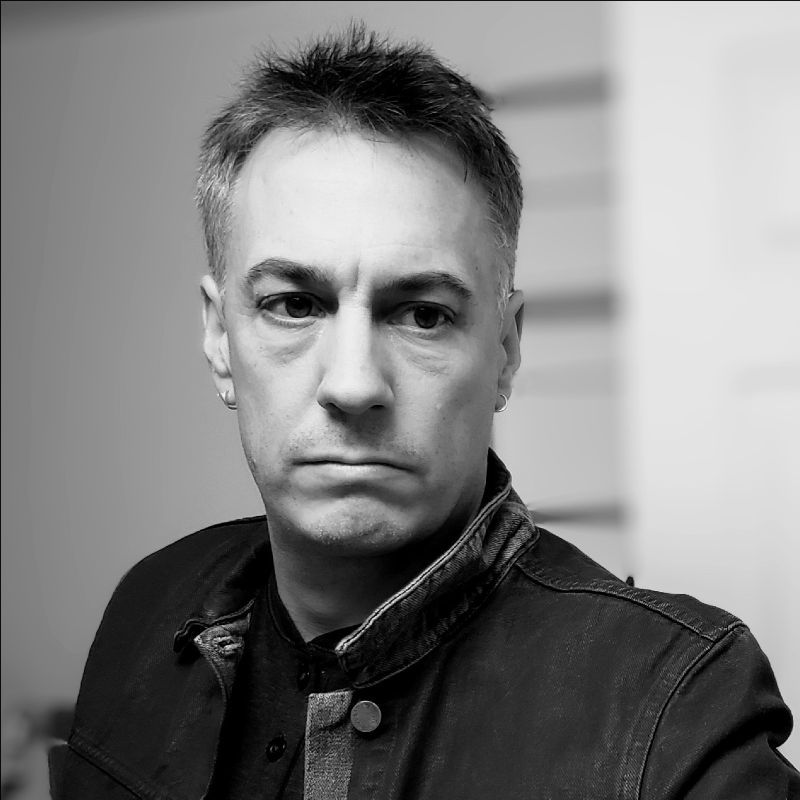
 David Cecchetto is Professor of Critical Digital Theory in the Department of Humanities at York University in Toronto, Director of the Graduate Program in Social and Political Thought, and a member of several Graduate Programs; he is also a Faculty Associate with Sensorium: Centre for Digital Arts and Technology and co-organizes the Tuning Speculation conferences and workshops as part of The Occulture. David is President of the Society for Literature, Science, and the Arts. He was a Series Editor of the para-academic Catalyst book series (Noxious Sector Press, 2016-2022) and is Co-Editor of the Proximities: Experiments in Nearness book series (University of Minnesota Press).
David’s most recent monograph, Listening in the Afterlife of Data, is available from Duke University Press. His first monograph, Humanesis: Sound and Technological Posthumanism (2013), was released on the Posthumanities series of the University of Minnesota Press. David edited My Computer Was a Computer (Noxious Sector Press, 2022), Something Other Than Lifedeath (Noxious Sector Press, 2018), and Phono-Fictions and Other Felt Thoughts (Noxious Sector Press, 2016), and co-edited Collision: Interarts Practice and Research (CSP, 2009). As a member of The Occulture, he is co-author of Ludic Dreaming: How To Listen Away From Contemporary Technoculture (Bloomsbury, 2017).
As a sound artist, composer, and quasi-practicing non-musician, David has presented creative work in Canada, the United States, the United Kingdom, Mexico, Russia, and on the web. An unmaintained archive of some of this work is available here. Most recently, he performs and records as part of Bitstance; their album Array (triple underscore records) is available on Bandcamp, Spotify, and other streaming platforms.
- Listening in the Afterlife of Data. Chapel Hill, NC: Duke University Press, 2022.
- My Computer Was a Computer (Catalyst: M. Beatrice Fazi), ed. USA: Noxious Sector Press (Catalyst Book Series), 2022.
- Something Other Than Lifedeath (Catalyst: Sylwia Chrostowska), ed. USA: Noxious Sector Press (Catalyst Book Series), 2018.
- Ludic Dreaming: How To Listen Away From Contemporary Technoculture, authored with with Marc Couroux, Ted Hiebert, and Eldritch Priest (as The Occulture). London, UK: Bloomsbury, 2017.
- Phono-Fictions and Other Felt Thoughts (Catalyst: Eldritch Priest), ed. USA: Noxious Sector Press (Catalyst Book Series), 2016.
- Humanesis: Sound and Technological Posthumanism. Minneapolis: University of Minnesota Press, 2013.
- Collision: Interarts Practice and Research, ed. (with Nancy Cuthbert, Julie Lassonde, and Dylan Robinson). UK: Cambridge Scholars Publishing, 2008.
- "Four Experiments in Broadband Auralneirics," in symplokē. Vol. 23, no. 1-2 (2015), 111-118.
- "The Sonic Effect: Aurality and Digital Networks in 'Exurbia'" in Evental Aesthetics. Vol. 2, no. 2 (September, 2013), 34-62.
- "Nonsense Aesthetics: (Imaginary) Living After the Death of Falsity" (review essay) in CTheory.net (October, 2012).
- “Deconstructing Affect: Posthumanism and Mark Hansen’s Media Theory” in Theory, Culture, and SocietyTheory, Culture, and Society. Vol. 28, no. 5 (Sept. 2011), 3-33.
- “Sounding the Hyperlink: Skewed Remote Musical Performance and the Virtual Subject” in Mosaic: a Journal for the Interdisciplinary Study of Literature. Vol. 42, no. 1 (March, 2009), 1-18.
- “vagant(ana)music: Three (four) Plateaus of a Contingent Music” in Radical Musicology. Volume 2 (International Centre for Music Studies at Newcastle University, December 2007), c. 8,000 words (http://www.radical-musicology.org.uk/).
- “The Auditory Hallucination,” authored with Marc Couroux, Ted Hiebert, Eldritch Priest, and Rebekah Sheldon (as The Occulture). In Unsound:Undead, edited by Steve Goodman, Toby Heys, and Eleni Ikoniadou, 109-112. UK: Urbanomic, 2019.
- “An( )Alibic Aural Tetrad: A Fourfold Structure of Ecologicity.” In Plastic Blue Marble (Catalyst: Amanda Boetzkes), edited by Ted Hiebert, 141-158. USA: Noxious Sector Press (Catalyst Book Series), 2016.
- “Algorithms, affect, and aesthetic listening.” In The Routledge Companion to Sounding Art, edited by Marcel Corbussen, Vincent Meelberg, and Barry Truax, 413-426. London: Routledge, 2016, 413-426.
- “Modernism and Music in Canada and the United States” (co-author, Jeremy Strachan). In The Modernist World, edited by Allana Lindgren and Stephen Ross, 546-554. London: Routledge, 2015.
- “Listening Aside: An Aesthetics of Distraction in Contemporary Music” (co-author, eldritch Priest). In Resonances: Noise and Contemporary Music, edited by Michael Goddard, Benjamin Halligan, and Nicola Spelman, 209-221. London and New York: Continuum-Bloomsbury, 2013.
- “Melancholy and the Territory of Digital Performance.” In Collision: Interarts Practice and Research. Edited by David Cecchetto, Nancy Cuthbert, Julie Lassonde, and Dylan Robinson, 77-90. UK: Cambridge Scholars Publishing, 2008.
- “Ethical and Activist Considerations of the Technological Artwork. In Transdiscplinary Digital Art: Sound, Vision, and the New Screen, edited by Randy Adams, Steven Muller Arisona, and Steve Gibson, 15-25. Communications in Computer and Communication Science Series. USA: Springer, June 2008.
For information about current and future teaching, please visit his York Faculty Page.